 Trumpcoin
Trumpcoin's FreedomCoin Core client needs RPC credentials to query a running node.
Trumpcoin became FreedomCoin, whose Core command-line setup requires an RPC username and password. RPC, or remote procedure call, lets a client request information from a running node. The coin uses its own proof-of-stake blockchain. The command-line client can query that node without requesting a wallet transfer. Successful authentication establishes access to the service; the returned information describes the contacted node and its state.
What's inside
FreedomCoin Core's RPC includes a shutdown command, so query credentials should be treated as node administration secrets.
A Core daemon for repeatable node queries
Tasks requiring repeatable queries against a Core node fit the command-line interface, provided the node is running and the client can authenticate. The
freedomcoind
daemon runs the node, while
freedomcoin-cli
requests individual operations. Installing a client alone does not provide a running service. A desktop wallet provides an alternative interface for direct wallet interaction. Command-line access becomes useful when a terminal session or script needs a node response.
Authentication and a private administration endpoint
RPC credentials deserve protection because Core exposes administrative operations alongside information queries. Its
stop
method requests node shutdown, so query credentials should not be assumed to grant read-only access. Credentials and endpoint exposure therefore matter even when the intended task only involves viewing information.
RPC authentication does not provide transport encryption; HTTP Basic credentials remain recoverable by anyone who obtains their encoded form. An unencrypted connection can consequently expose the login to someone able to inspect its traffic. Keep local administration local; remote access needs a protected communication path.
Use an RPC password separate from a wallet encryption passphrase or private key, because reusing secrets across these different operations creates unnecessary exposure. Restrict access to configuration files containing credentials, and remove secrets from screenshots, diagnostic extracts, and script output before sharing them.
A successful query does not establish that an endpoint is safe to expose publicly. Network access restrictions remain a separate protection.
Configuration for the intended node
The client must present credentials accepted by the node it contacts. FreedomCoin Core's command-line setup requires an RPC username and password. These belong to the node connection, rather than a coin address or exchange account.
The Linux command-line setup places configuration in
~/.freedomcoin/freedomcoin.conf; this path should not be copied unchanged across operating systems. Preserve the configuration location an existing installation actually uses. Access configuration and the files holding blockchain or wallet data serve different purposes.
Retaining the previous working configuration makes an access change easier to reverse. A credential correction does not require replacing wallet files or deleting blockchain data.
Compare the client settings with the intended node settings without publishing either password. Similar filenames do not establish which files both processes read, and edits on disk do not establish a running process's settings. Keep the saved configuration, active process, and client connection aligned before interpreting an authentication failure.
A local query before wallet changes
A local blockchain-information query provides an access check without requesting a transfer. In the source-build layout, begin with built Core executables and access to the node configuration. Keep its prior working settings before changing credentials. The daemon must start before its command-line client can obtain a response.

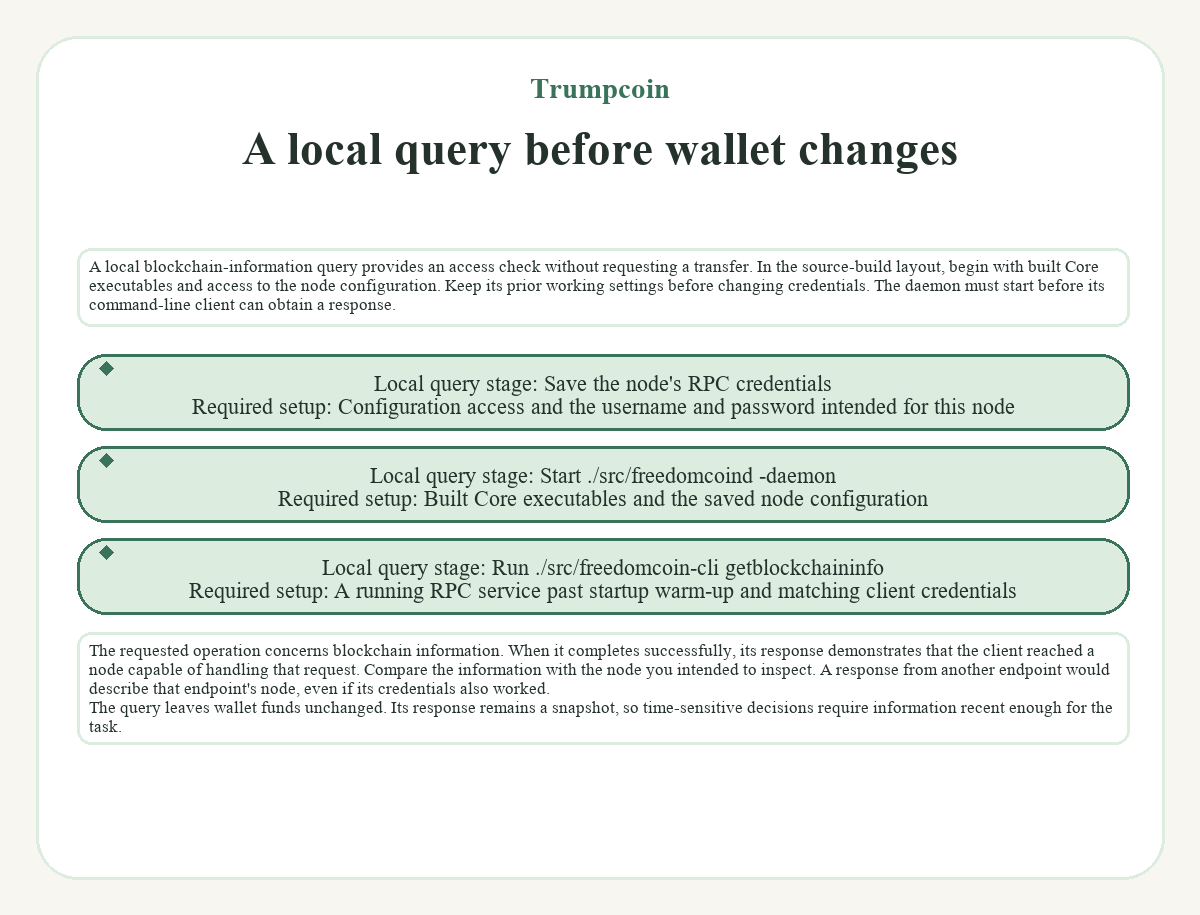
| Local query stage | Required setup |
|---|---|
| Save the node's RPC credentials | Configuration access and the username and password intended for this node |
Start
./src/freedomcoind -daemon
|
Built Core executables and the saved node configuration |
Run
./src/freedomcoin-cli getblockchaininfo
|
A running RPC service past startup warm-up and matching client credentials |
The requested operation concerns blockchain information. When it completes successfully, its response demonstrates that the client reached a node capable of handling that request. Compare the information with the node you intended to inspect. A response from another endpoint would describe that endpoint's node, even if its credentials also worked.
The query leaves wallet funds unchanged. Its response remains a snapshot, so time-sensitive decisions require information recent enough for the task.
Networking fields returned by getnetworkinfo
The
getnetworkinfo
method describes node networking, which helps distinguish RPC access from connections to other blockchain nodes.
Its output includes the server version and protocol version. The
connections
field, when present, counts peer connections. These peers exchange network information with the node; they are different from the command-line client making an administrative request.
RPC authentication can succeed while peer connectivity needs attention, and a working administrative connection does not establish blockchain synchronization.
Networking information includes warning text and reported local addresses, which can reveal operational details even when the response contains no password. Remove sensitive host information before sharing a diagnostic response. Trading liquidity belongs to market activity, so a successful node query does not establish an exchange's available trading depth.
How does Core describe an RPC method's arguments?
Core's
help
method lists commands or returns detailed help for a specified command. The command-line form
freedomcoin-cli help getnetworkinfo
requests the networking method's description. Command-specific help describes the expected arguments and response, keeping an integration tied to the node's interface when similarly named commands elsewhere have different parameters.
Preserve method names, argument types, and identifier spelling when building requests. Human-readable descriptions can vary; a program's field names need exact handling.
In a direct JSON-RPC response,
result
carries the method output and
error
reports a method failure. An application must examine the error state before treating the result as usable information, because a reply object alone does not establish success. A networking result also has a different meaning from a wallet operation's result.
Startup warm-up and RPC failures
FreedomCoin Core refuses RPC method execution while its RPC service is in warm-up. Changing a password cannot complete that initialization. A read-only retry becomes useful after the service leaves warm-up; repeated immediate calls do not remove the condition.
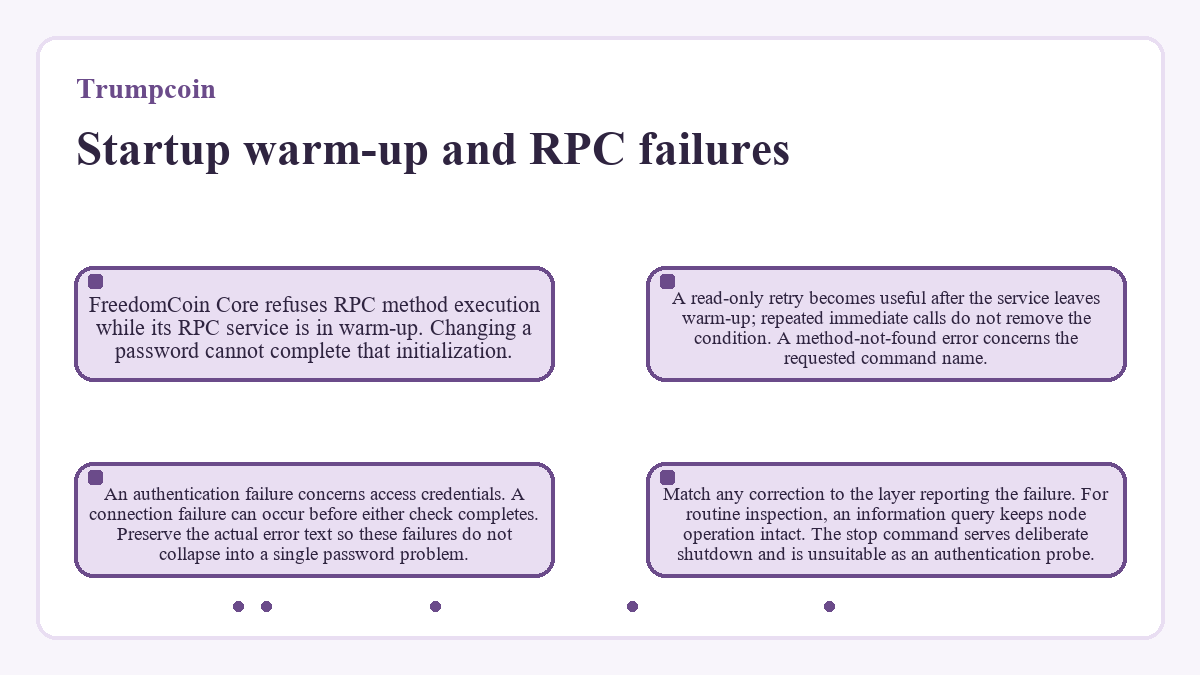
A method-not-found error concerns the requested command name. An authentication failure concerns access credentials. A connection failure can occur before either check completes. Preserve the actual error text so these failures do not collapse into a single password problem. Match any correction to the layer reporting the failure.
For routine inspection, an information query keeps node operation intact. The
stop
command serves deliberate shutdown and is unsuitable as an authentication probe.
What readers ask about Trumpcoin
Does a blockchain-information query incur a FREED transaction fee?
A read-only blockchain-information query does not create an on-chain transaction, so the query itself incurs no FREED transaction fee. It requests information from the node. A wallet transfer is a separate operation with its own transaction requirements; successfully querying the node does not submit that transfer.
Do I need a FREED balance to request getnetworkinfo?
The getnetworkinfo method does not require a FREED wallet balance. It reads the node's networking state rather than spending coins or testing staking eligibility. The relevant access requirements concern the running RPC service and client authentication. Holding coins and meeting Patriot Node collateral requirements serve different network functions.
Why might getnetworkinfo omit the connections field?
Core includes the connections field only when its peer-to-peer connection manager is available. A missing field therefore differs from a reported count of zero. Software reading the response should preserve that distinction instead of silently substituting zero. Other fields, including the server version, describe the running software.
Is a JSON-RPC request ID the same as a blockchain transaction ID?
A JSON-RPC request ID matches a response to its request and does not identify a blockchain transaction. For a valid request, the reply returns the corresponding request ID, including when the method reports an error. A transaction identifier belongs to a separate blockchain object and has a different purpose.
How does Core handle an unrecognized named RPC parameter?
Core rejects an unrecognized named RPC parameter with a parameter error. When a request supplies named arguments, Core maps the recognized names to the method's expected arguments and rejects names left unmatched. Changing login credentials does not resolve that mismatch. The correction belongs to the request's argument names.