 Trumpcoin
Trumpcoin supply reflects FreedomCoin's block rewards, fee destruction, and monetary limits.
Trumpcoin supply, for the project renamed FreedomCoin, changes as the network issues FREED coins and destroys transaction fees. New coins enter through proof-of-stake block rewards governed by block height. FreedomCoin Core 5.4.1.1 uses a 36,900,000 FREED mainnet parameter to limit the regular subsidy. The live total remains distinct from that limit and from the value of any staking output.
A staking payout can include coins already held by its recipient. A supply figure can also lag behind the latest block when a node returns cached data. Both distinctions affect how issuance, accessible balances, and market circulation relate to one another.
Mainnet totals and stale cache entries
A synchronized FreedomCoin mainnet node can report supply, while its default query can retain a transparent balance from an earlier height. The query client needs authenticated access to the running node. The
getsupplyinfo
response contains
transparentsupply,
shieldsupply, and
totalsupply. Its
updateheight
identifies the height of the cached transparent calculation. The shielded component comes from the chain tip, so the components can have different height contexts.
The
getsupplyinfo true
form requests a chain-state flush and supply-cache update. Compare the returned updateheight with the node's current mainnet block height before treating the transparent figure as current. Core skips the cache update during initial block download, so a catching-up node remains an incomplete view of the network. A refresh affects the reported information; it creates no coins.
New coins inside a staking transaction
A FreedomCoin staking transaction combines previously owned coins with a protocol reward, so its output total exceeds the newly created amount.
Coinstake accounting
A coinstake transaction spends existing outputs and creates replacement outputs. Their combined value carries the original principal and reward allocations. Payments to other recipients use separate outputs within the same transaction.
Returned principal
The staking input supplies the baseline for calculating the staker's gain. The returned value includes that principal and the staker's reward share. An output value alone therefore cannot identify the gain.
Payment allocation
The standard payment path in Core 5.4.1.1 divides an ordinary 9 FREED subsidy among the staking participant, a Patriot Node, and the development payment. When both separate payments apply, the Patriot Node receives 4.5 FREED, the development output receives 0.9 FREED, and the staker's reward portion is 3.6 FREED. These allocations belong within the regular subsidy. Adding them on top of the full block reward would overstate issuance.
How does block height determine the block subsidy?
FreedomCoin Core 5.4.1.1 schedules a regular 9 FREED subsidy from height 1707030 through height 10000000, subject to its monetary-limit check. Earlier height brackets assign different amounts. Consequently, multiplying every historical block by the later subsidy cannot reconstruct the chain's supply. Accepted block history, actual minting, and destroyed fees determine the change in recorded coins.
Extension beyond the earlier endpoint
Version 5.4.1.1 extends the existing subsidy bracket beyond height 3800000 and keeps the Patriot Node payment schedule aligned. Earlier code would have reverted to a 1 FREED regular subsidy after that endpoint. Nodes using the earlier schedule must upgrade before height 3800000 to follow the extension.
Height and calendar time
Mainnet targets a 60-second block interval, but actual block spacing varies. A reward boundary activates through chain progress. Its block height does not establish a fixed calendar date.
Supply totals, circulation, and the monetary limit
FreedomCoin supply measurements differ because they describe protocol limits, recorded balances, or market availability. A circulating-supply estimate classifies publicly available holdings. It does not replace the network's accounting of existing coins.
| Quantity | Meaning | Coverage | Required context |
|---|---|---|---|
| Configured subsidy limit | Ceiling used by the regular reward function | Bounds ordinary issuance | Applicable mainnet Core version |
| Reported total supply | Transparent amount plus shielded-pool value | Combined network accounting | Component heights and query mode |
| Transparent supply | Reported unspent transparent coin value | Transparent component of the total | Cache height and maintenance setting |
| Shielded-pool value | Aggregate value recorded in the shielded pool | Shielded component of the total | Pool record at the chain tip |
| Circulating-supply estimate | Coins classified as available in public markets | Market circulation | Provider exclusions and measurement date |
| Spendable wallet balance | Coins the loaded wallet can spend | One wallet's available holdings | Wallet state and output eligibility |
The regular subsidy function uses the cached transparent supply before the query's maintenance adjustment. It returns zero when that value plus the proposed subsidy reaches or exceeds the configured limit. This condition does not mean 36,900,000 FREED have already been issued. The query reduces the reported transparent supply when Core's Sapling maintenance setting is active. The reported total includes this reduction. Core uses zero for an unavailable shielded-pool value when constructing the total; that fallback does not establish an observed zero pool balance. Neither an issued total nor a circulation estimate states the trading liquidity available for a particular sale.
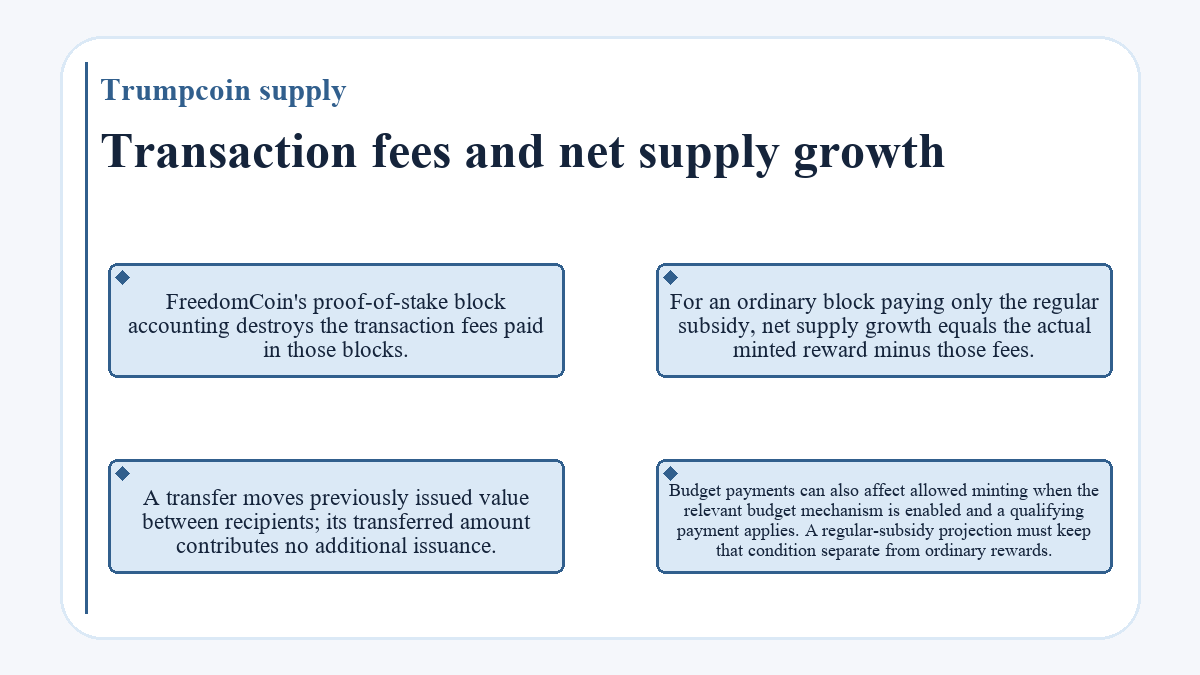
Transaction fees and net supply growth
FreedomCoin's proof-of-stake block accounting destroys the transaction fees paid in those blocks. For an ordinary block paying only the regular subsidy, net supply growth equals the actual minted reward minus those fees. A transfer moves previously issued value between recipients; its transferred amount contributes no additional issuance.
Budget payments can also affect allowed minting when the relevant budget mechanism is enabled and a qualifying payment applies. A regular-subsidy projection must keep that condition separate from ordinary rewards.
Rejected rewards and older validation code
Earlier Core releases could reject otherwise valid stake blocks because a payment-validation check used an uninitialized block-height variable. Core 5.4.1.1 corrects that defect. A rejected stake block contributes no reward to the active chain's balances.
The scheduled subsidy describes a block's permitted regular issuance. Holding FREED does not reserve a payment in every following block. A staking attempt must produce an accepted block before its reward enters the chain.
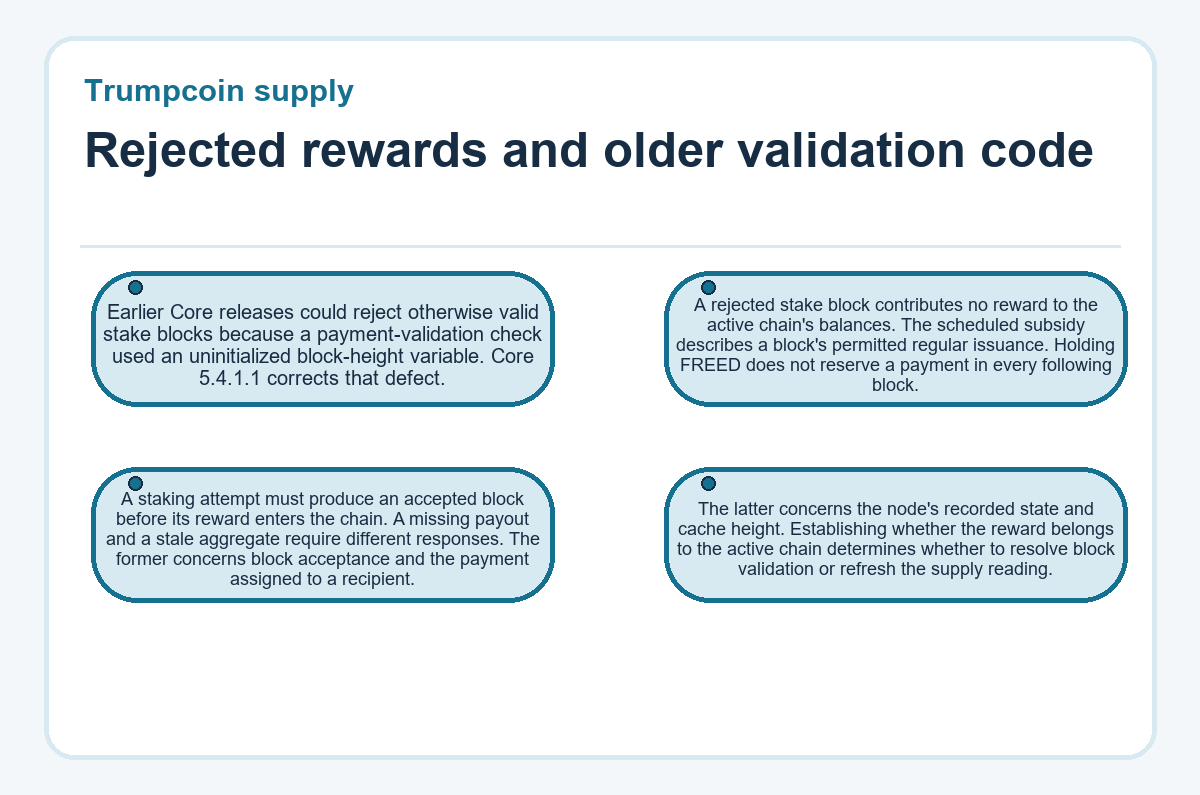
A missing payout and a stale aggregate require different responses. The former concerns block acceptance and the payment assigned to a recipient. The latter concerns the node's recorded state and cache height. Establishing whether the reward belongs to the active chain determines whether to resolve block validation or refresh the supply reading.
Trumpcoin supply: the short answers
-
How is FreedomCoin supply inflation calculated?
- Supply inflation over a chosen period equals the net supply increase divided by the starting supply, multiplied by 100. Both endpoint figures need the same accounting scope. This measures coin-supply growth over that period. It differs from an individual staking return, which depends on rewards received by the particular holding.
-
Are FREED coins with lost private keys removed from supply?
- Losing a private key does not remove its recorded coin balance from the chain. The network's output accounting does not know whether someone retains the key needed to spend an output. Such coins can remain in the recorded quantity even when their owner cannot transfer them.
-
Does splitting a staking output multiply the block subsidy?
- Splitting a staking transaction's returned value across outputs does not multiply its block subsidy. Core's regular subsidy calculation depends on height and the monetary-limit check. Output division distributes the transaction's value among outputs. It does not create an additional reward for every replacement output.
-
Can a chain reorganization change a FREED supply reading?
- A chain reorganization can remove rewards whose blocks leave the active chain. Core undoes the disconnected blocks' effects before applying the replacement branch. A supply reading then reflects the resulting recorded balances, subject to cache refresh. The old reward does not remain issued merely because a wallet previously displayed it.
-
Is Patriot Node collateral burned while the node operates?
- Patriot Node collateral remains recorded coin value while its output stays unspent. Reserving coins as collateral does not itself destroy them or create a new supply allocation. A market-data service may classify collateral separately when estimating circulation, so its circulating figure can differ from the chain's recorded supply.
-
When do newly generated FREED rewards become spendable?
- FreedomCoin Core 5.4.1.1 uses a 90-block mainnet maturity parameter for generated outputs. A reward's inclusion in chain accounting and its availability for spending are separate states. Maturity changes when the output can be used; it does not issue the same coins again. Variable block spacing prevents an exact wall-clock promise.