 Trumpcoin
Trumpcoin liquidity determines how much FREED can trade at the available prices.
Trumpcoin liquidity describes how readily FreedomCoin (FREED) can be bought or sold without substantially changing the execution price. Trumpcoin is the project's former name; the relevant asset here is FREED on FreedomCoin's blockchain. In an order-book market, available counterparty quantity within an acceptable price range determines executable size. Buying depends on sell orders, while selling depends on buy orders. A displayed last price alone cannot establish the price an entire order will receive.
Immediate matching and resting limit orders
An order priced to match compatible orders already in the book can execute immediately, while a resting limit order waits for new matching opportunities. A buy limit sets the maximum acceptable price; a sell limit sets the minimum. Either direction needs sufficient quantity on the opposite side of the FREED book. A limit can permit immediate matching, so selecting that order type does not necessarily mean waiting. Market orders, where supported, seek available prices without the same user-selected price boundary.
A tighter limit can leave part or all of an order unfilled.
Spread and nearby depth describe different constraints
The best bid is the highest price buyers offer; the best ask is the lowest price sellers request. The bid-ask spread is the difference between the highest bid and the lowest ask. Depth adds the quantities offered at those prices and subsequent levels. A narrow spread can coexist with very little FREED available near either quote.
Amounts in the book need their units. FREED quantity measures coins available for matching, while the quote asset measures their cost or proceeds. A cumulative column may show FREED or quote-asset value, depending on the interface. Comparing both sides requires reading those labels consistently. Coin supply measures a different object: coins in the network do not automatically become orders. Only quantities offered in the selected book contribute to its displayed depth. Distant orders enlarge total displayed depth without necessarily increasing the quantity available inside a chosen price range.
How does order size change the execution price?
Order size changes the execution price when the requested quantity exceeds available depth at the best price and matching continues through further levels. With an unchanged book, selling beyond the quantity at the best bid requires lower bids, provided the order permits those prices. Buying follows the opposite direction through higher asks. Gaps between price levels increase the price change caused by consuming additional depth.
Each fill contributes its own quantity and price to the trade's overall average. The average execution price equals total quote-asset value exchanged divided by total FREED filled, before fees. This quantity-weighted calculation distinguishes an entire trade from its final fill. Price impact describes the effect of consuming available liquidity. Slippage compares execution with an expected price and can also reflect changes occurring before matching. The expectation needs a clear reference, such as the quoted best bid.
A partial fill has an average for the executed portion. Its unfilled remainder has no execution price or sale proceeds.
Why can liquidity change before an order fills?
Liquidity can change before an order fills because other participants can execute or cancel the orders shown in the book. An earlier snapshot therefore describes availability at that moment.
Trading volume measures completed trades over a reporting period. Book depth describes outstanding orders, so these measures answer different questions. Repeated small trades can produce activity without leaving enough nearby quantity for a larger order. Conversely, resting bids can exist during a period with few completed trades. A last-traded price may persist after the orders supporting it disappear. Neither trade history nor a chart replaces the quantities currently offered on the relevant side.
Depth also belongs to a particular trading pair and venue. Orders elsewhere cannot fill an order in the selected book. Different quote assets complicate direct price comparisons because their values need a common basis. Moving funds between venues introduces transfer conditions and additional elapsed time. The other book may change before those funds become available. Combining several venues' displayed depth therefore does not establish what an order in the selected book can execute immediately.
Waiting preserves a price limit, but it cannot establish when compatible orders will arrive.
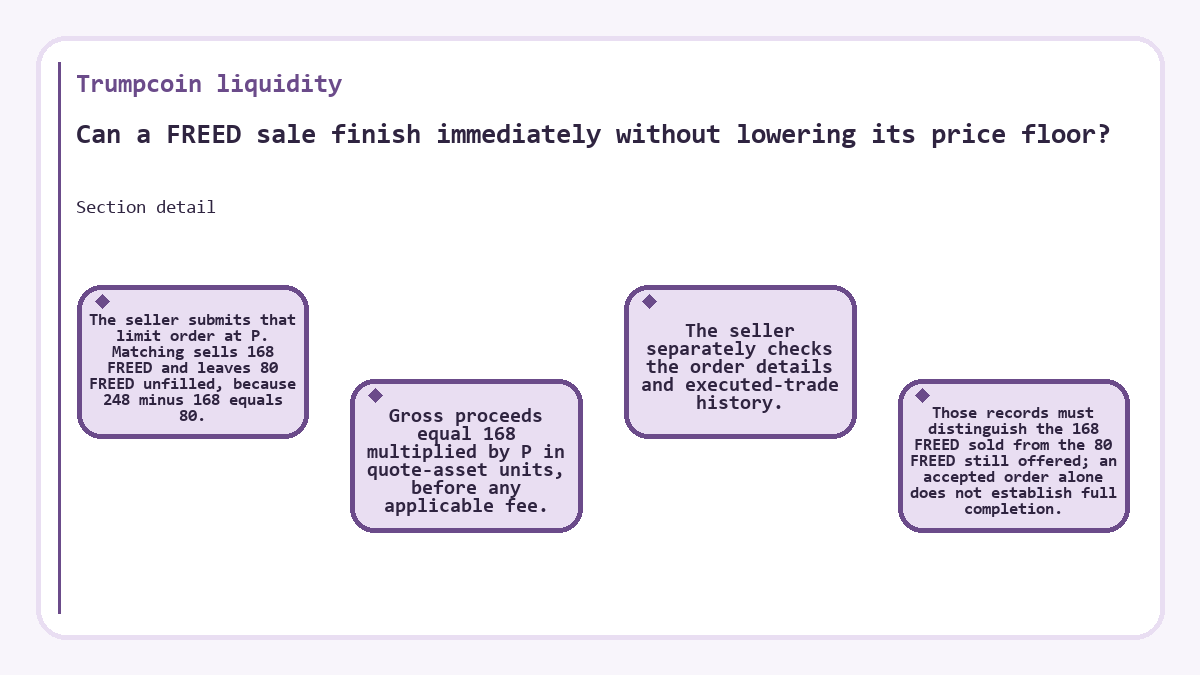
Can a FREED sale finish immediately without lowering its price floor?
A FREED sale can finish immediately at or above its price floor only if sufficient compatible bids remain available during matching. Consider a hypothetical sale in which every balance, quantity, price, and book condition is illustrative.
The seller wants to sell 248 FREED without accepting less than price P per coin. P uses the selected market's quote-asset units. The exchange balances cover the sale and any fee in its charging asset, and the market accepts the order size. Bids offer 168 FREED at P; all other bids sit below P. The interface permits an ordinary sell limit with its unfilled remainder left open. Assume the displayed bids remain available until matching occurs.
The seller submits that limit order at P. Matching sells 168 FREED and leaves 80 FREED unfilled, because 248 minus 168 equals 80. Gross proceeds equal 168 multiplied by P in quote-asset units, before any applicable fee. The seller separately checks the order details and executed-trade history. Those records must distinguish the 168 FREED sold from the 80 FREED still offered; an accepted order alone does not establish full completion.
Continuing at P requires additional compatible bids. Waiting leaves the remainder exposed to an unknown fill time. If immediate completion is essential, the seller can instead request cancellation of the outstanding portion to stop further matching, then check its final status. Reducing the limit would admit lower bids and change the price condition. Keeping the floor preserves that condition while leaving the sale unfinished.
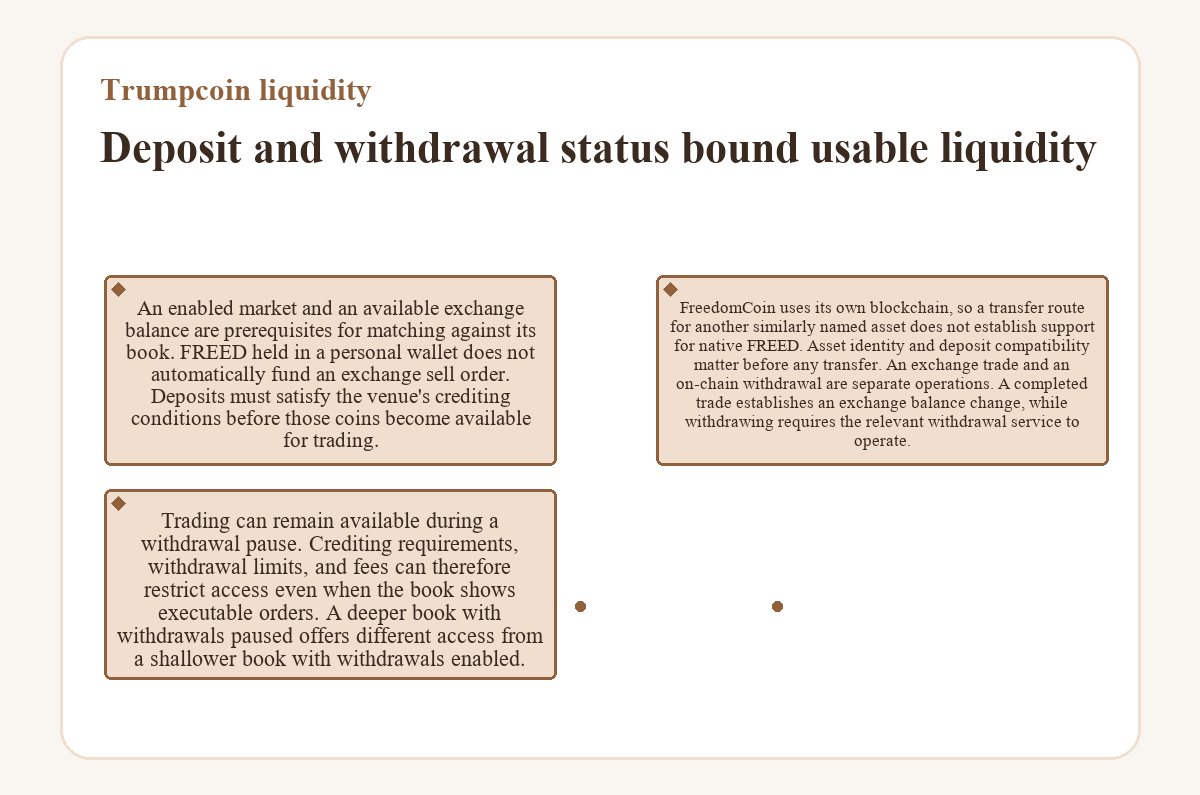
Deposit and withdrawal status bound usable liquidity
An enabled market and an available exchange balance are prerequisites for matching against its book. FREED held in a personal wallet does not automatically fund an exchange sell order. Deposits must satisfy the venue's crediting conditions before those coins become available for trading. FreedomCoin uses its own blockchain, so a transfer route for another similarly named asset does not establish support for native FREED. Asset identity and deposit compatibility matter before any transfer.
An exchange trade and an on-chain withdrawal are separate operations. A completed trade establishes an exchange balance change, while withdrawing requires the relevant withdrawal service to operate. Trading can remain available during a withdrawal pause. Crediting requirements, withdrawal limits, and fees can therefore restrict access even when the book shows executable orders. A deeper book with withdrawals paused offers different access from a shallower book with withdrawals enabled.
Details worth knowing about Trumpcoin liquidity
Does staking FREED create buying interest in an exchange order book?
Staking FREED does not automatically create exchange bids. Staking participates in FreedomCoin's proof-of-stake network, while a bid offers to buy coins at a stated price. Staking rewards can change the amount a holder owns. They establish no quantity an exchange buyer will purchase.
Are FREED trading fees part of the bid-ask spread?
The bid-ask spread excludes separately charged trading fees. It measures the gap between the best buy and sell quotes. A fee schedule determines charges on executed trades, where applicable. Comparing net proceeds requires both the actual fill prices and the fee's amount and charging asset. Withdrawal fees concern later transfers and should not be mistaken for a price gap.
Why can a FREED limit order incur a taker fee?
A FREED limit order can incur a taker fee when it immediately matches an existing order under a venue's maker-taker schedule. Its price limit controls acceptable prices, while its matching behavior determines whether it takes liquidity. A later fill of a resting remainder may receive different fee treatment. Supported execution settings and the applicable fee schedule determine the exact charge.
Can canceling a partially filled FREED order undo completed trades?
Canceling a partially filled order does not reverse completed fills. Cancellation removes the confirmed canceled remainder from further matching. Additional execution may occur before the cancellation takes effect, so the final canceled quantity can differ from the quantity previously shown. The exchange's final order status and executed-trade record establish how much traded before cancellation completed.
Is missing FREED volume data proof that a market has no buyers?
Missing volume data does not establish that a market has no buyers. A blank field can represent unavailable reporting rather than measured inactivity. Recent trades and a functioning bid book answer different questions about that market. Even a reported period with no completed trades can coexist with outstanding bids, because orders only contribute trading volume when matching executes them.